What cavity wall insulation removal involves.
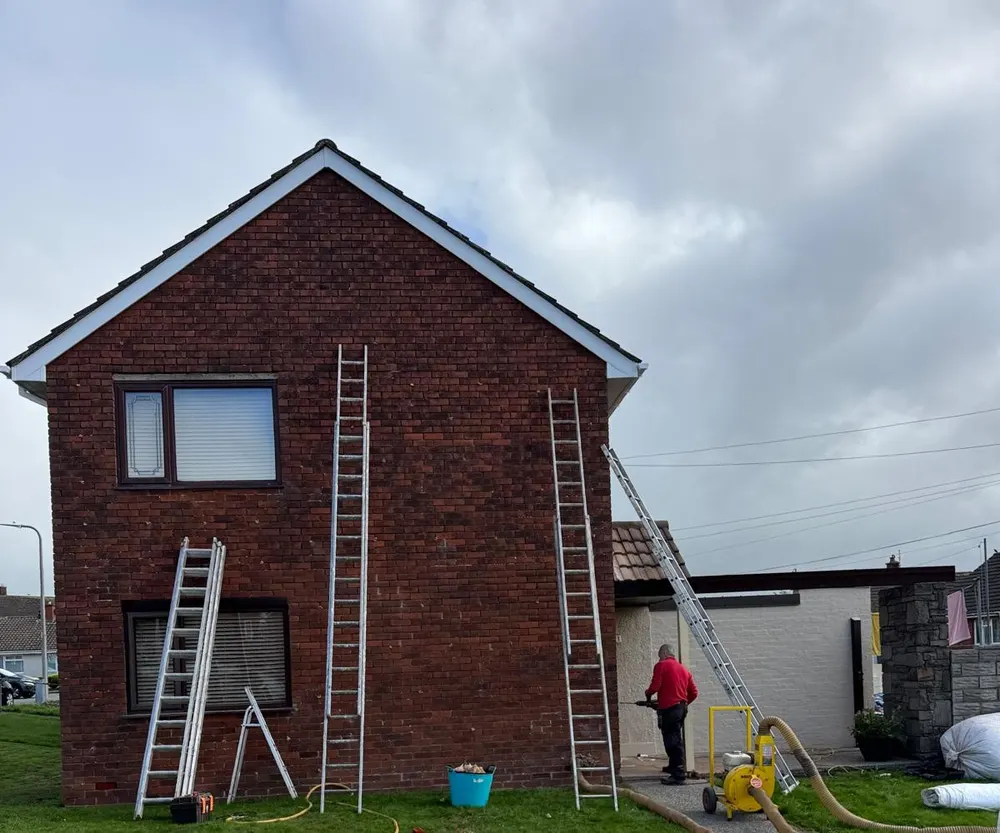
Cavity wall insulation removal means taking failed or unsuitable fill out of the gap between the two layers of an outside wall. We check the wall with a borescope, drill a set pattern of holes, vacuum the fill out down to the damp-proof course, then fill every hole and fit air bricks.
Most of the houses we work on had their cavity walls filled years ago. Sometimes it was the right job and it's simply failed with age, and sometimes the wall was never suitable in the first place. Either way, once the fill has got wet, slumped or packed down, the only real fix is to take it out. We don't sell windows or boilers, and we don't fill cavities. Every job follows the same steps.
- We check what's in the wall. Before any work is booked we come out with a borescope, a small camera that goes into the cavity through a tiny hole. It shows us the type of fill and its condition, and we measure the wall area so the price is right.
- We drill in a set pattern. Holes go into the mortar or brick in a planned grid, so the extraction hose can reach every part of the cavity.
- We vacuum it out. The insulation comes out through an industrial vacuum, all the way down to the damp-proof course, so nothing is left sitting at the bottom of the wall.
- We make good every hole. Each hole is filled and finished so it blends in with the wall around it.
- We fit air bricks. These let air move through the cleared cavity.
Removed insulation is bagged and taken away for licensed disposal. You don't have to deal with any of it.
The three types of fill we take out.
There are three main kinds of cavity wall insulation in British homes: mineral wool, polystyrene beads and foam. Each one comes out a little differently, and foam costs more because it has to be broken up first. The borescope check tells us which one you've got before we quote.
- Mineral wool extraction. Blown fibre, often called rockwool or glass wool, and the most common fill in older retrofits. When it gets wet it tends to sag and clump.
- Polystyrene bead extraction. Small white beads, either loose or bonded with glue. Loose beads can run out of any gap, so they need careful handling.
- Foam insulation extraction. Foam that was injected and set hard in the cavity. It has to be broken up before it can be removed, which is why it costs more per square metre.
If you don't know what's in your walls, that's fine. Most people don't, and it's the first thing we find out.
Why people get in touch.
People usually ring us because something's changed indoors: cold spots on walls, damp patches, mould or a musty smell, and heating bills that keep creeping up. Others come to us because a surveyor has flagged the insulation when they're buying or selling, or because the old fill has to come out before a different type goes in.
We'll tell you honestly what we find in the cavity, and if extraction isn't the answer for your walls, we'll say so.
What you get when we're finished.
When the job's done you get photos of the empty cavity, so you can see for yourself that the insulation has gone, and a certificate of removal. Keep the certificate with your house paperwork, especially if you're selling or a surveyor or mortgage lender asks about the walls.
We're fully insured, and the holes are filled and the air bricks are in before we leave.
How much it costs.
Our prices (as of November 2026) are worked out per square metre of wall: £21/m² for mineral wool, £21/m² for polystyrene beads and £31/m² for foam, with a minimum job of £1,250. A two storey semi with three or four walls to clear comes to about £3,110 for wool or beads.
The estimator at the top of this page uses the same rates and gives you a guide price for all three in about a minute. You'll get a fixed price once we've done the borescope check and measured the walls. Our cavity wall insulation removal cost guide shows how the figures are worked out, with examples for different house types.
Watch an extraction.
This is one of our jobs, filmed from start to finish, so you can see what the kit looks like and what actually happens on the day. If you'd like to talk through what you've seen, or what would happen at your house, ring us on 07728 291907 and we'll go through it with you.
Where we work.
We're based in Llanelli, and most of our jobs are across South Wales, from Pembrokeshire and Carmarthenshire through Swansea, Bridgend and Cardiff to Newport and Monmouthshire. We also take enquiries from across the UK, so it's worth a call wherever you live. Enquiries from the north of England are passed to our partner, CavExtract.
We work on houses and on larger jobs too. Housing associations, councils, landlords and demolition contractors can read how we handle those on our commercial page.
What our customers say.
"We used Cavity wall extraction UK. Stephen explained the process and used a camera to show us the blocked /Damp cavities. Also photos were taken after the work was carried out. The team arrived on time were respectful to my family and property. They cleaned up and took the debris away with them. Leaving everything spotless. There were no hidden costs and the bill was as initially quoted. I highly recommend this company"
Lynne, 5 stars on Trustpilot, September 2026
"The company were easy to contact, spent time answering questions, beforehand and returned phone calls promptly. The process of cavity wall insulation was a big job, but they carried it out efficiently and effectively, on time, as planned. They were approachable and professional, happy to discuss the process and provide advice."
Trustpilot reviewer, 5 stars, October 2026
Read our reviews on Trustpilot.
Questions people ask us.
Can I remove cavity wall insulation myself?
We wouldn't recommend it. Getting the fill out properly needs an extraction vacuum built for the job, holes drilled in the right pattern so the hose reaches every part of the wall, and the waste taken away for licensed disposal. If some is left behind, especially at the bottom of the cavity, the problem you were trying to fix can stay. It's also hard to show a buyer or surveyor that the job was done properly without photos and a certificate.
How do you know what type of insulation is in my walls?
We look. A borescope camera goes into the cavity through a small hole and shows us the fill and its condition. We do this before any work is booked.
Will you leave holes in my walls?
No. Every hole we drill is filled and made good before we leave, and air bricks are fitted to ventilate the cleared cavity.
What happens to the insulation you take out?
It's bagged on site and taken away for licensed disposal.
Is the estimator price what I'll pay?
It's a guide price based on your answers. The fixed price comes after we've checked the walls and measured them on site.
Do you only work in South Wales?
South Wales is our base, but we take enquiries from across the UK. Give us a ring or use the estimator and we'll let you know. You can find all our details on the contact page, and a bit more about us on the about page.
Get a guide price for your walls.
The estimator takes about a minute. Or ring us and we'll talk it through.
Get my free estimateCall 07728 291907