
Foam cavity wall insulation removal
Foam is the hardest of the three cavity fills to get out. Unlike fibre or beads, it was injected as a liquid and set solid inside the wall, so it can't just be sucked out. It has to be broken up first. That's why foam removal is priced higher than wool or beads, and why it's worth getting someone who does it often.
Why foam is a different job.
Foam insulation went into cavities wet and then cured in place. Once it's set, it fills the gap between the two leaves of brickwork as one mass, often stuck to the inner faces of both walls. There's nothing loose for a vacuum to pick up.
So removing it means breaking the foam into pieces small enough to come out through holes in the outer wall, then extracting those pieces. It's slower, more physical work than a wool or bead job, and getting the last of it off the brick faces and out of the bottom of the cavity takes patience.
Some older foams also go brittle or crumbly with age, and in some walls the foam has shrunk and pulled away in places. You won't know what yours is like until it's been looked at.
What makes people want foam out.
We get calls about foam for much the same reasons as the other fills: cold or damp patches on outside walls, mould that keeps coming back, a musty smell, or a surveyor raising questions when a house is being sold. We'll look at your wall and give you a straight answer about whether removal is worth doing.
We won't promise that taking foam out will fix a damp problem on its own. Damp can have more than one cause. What we can do is get the cavity empty and ventilated and show you it's clear.
The survey comes first.
Before we book anything, we check the cavity with a borescope. It's a small camera that goes in through a tiny hole, and it lets us (and you) see the fill on a screen. It confirms that it's foam rather than wool or beads, shows how it's sitting, and lets us measure the wall area properly.
If it turns out to be a different fill, the job changes, and so does the price. Our mineral wool and polystyrene bead pages explain those.
How foam removal works.
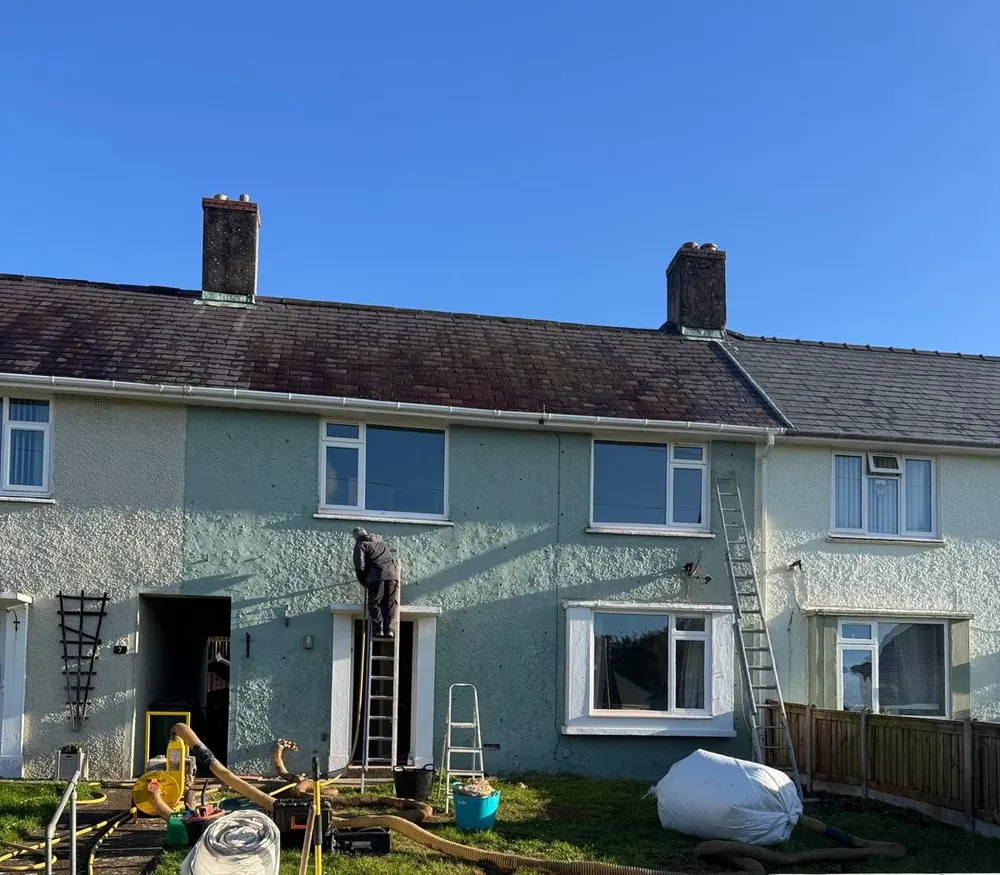
The day starts with drilling the outer leaf of the wall in a set pattern, so we can get at the whole cavity. Then the foam is broken up inside the wall and the pieces are extracted through the holes into bags. We work across and down until the cavity is clear to the damp-proof course.
When the foam's out, we fill and make good every hole we've drilled and fit air bricks so the empty cavity is ventilated. All the removed foam is bagged and taken away for licensed disposal.
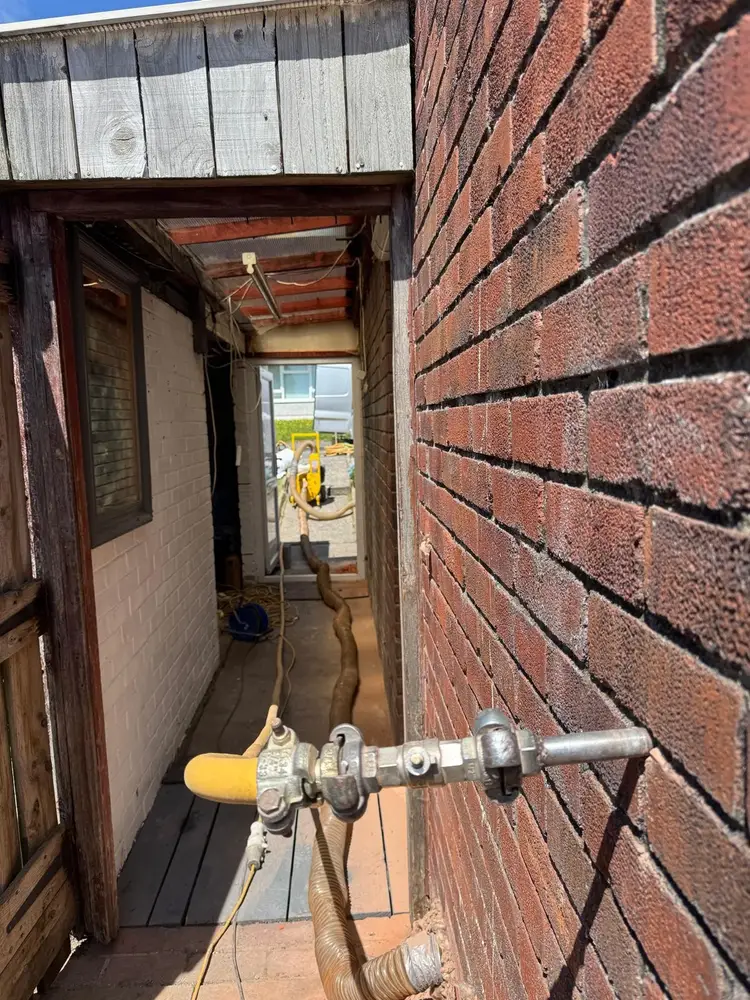
Narrow passages, tall gables and awkward back walls are all part of the job. We bring ladders and enough hose to reach the wall wherever it is.
Proof the foam's gone.
At the end you get photos of the empty cavity and a certificate of removal. Keep them with your house papers. If you sell later, they answer the question a buyer's surveyor is likely to ask. And we're fully insured for the work.
How much foam removal costs.
Because it takes more work, our estimator prices foam at £31 per square metre of wall (as of November 2026), against £21 for wool or beads. The minimum job is £1,250. Wall area comes from your house type, storeys and the number of walls being done, and the cost guide walks through how it's worked out.
You can get a guide price in about a minute from the estimator on our home page. That's a guide, not a quote: the fixed price comes after the borescope survey.
Where we work.
We're a Llanelli company, and most of our foam removal is across South Wales, from Pembrokeshire and Carmarthenshire across to Cardiff and Newport. We take enquiries from all over the UK as well. Enquiries from the north of England go to our partner, CavExtract.
Foam removal questions.
Can all the foam be got out?
We work until the cavity is clear down to the damp-proof course, and the photos we take afterwards show you the result. If there's anything unusual about your wall, we'll tell you on the survey before you book.
Why is foam dearer than wool or beads?
Because it's set solid. It has to be broken up before it can be extracted, which takes longer and is harder work. That's reflected in the £31 per square metre rate.
Is the work done from inside the house?
No. We drill and extract from the outside wall, and the foam comes out through the hoses into bags outside.
Could I break the foam up and remove it myself?
We'd advise against it. Breaking set foam inside a closed cavity and getting every piece out is hard without the right kit and a proper drilling pattern. The waste also has to go for licensed disposal, and you'd have no certificate to show for it.
Want the bigger picture? Our cavity wall insulation removal page covers all three fills and how we work.
Get a guide price for your walls.
Our online estimator gives you a guide price in about a minute. Or ring us and we'll talk it through.
Get my free estimateCall 07728 291907