
Polystyrene bead cavity insulation removal
Polystyrene beads are the small white balls you might have seen spilling out when someone drilled into an outside wall. They were pumped into a lot of cavities, sometimes on their own and sometimes mixed with a glue. Getting them out properly is a different job to taking out fibre, and it's one we do regularly.
Loose beads and bonded beads.
There are two kinds of bead fill. Loose beads are thousands of small polystyrene balls that flow like dry sand, while bonded beads were mixed with glue so they set together in the cavity. Loose beads are easier to vacuum out but escape through any gap, so it helps to know which you've got.
Loose beads are exactly that: thousands of little polystyrene balls poured or blown into the cavity. They flow a bit like dry sand. That makes them easier to draw out with a vacuum, but it also means they'll run out of any gap they can find, including a vent, a hole drilled for a cable or a cracked bit of mortar.
Bonded beads were mixed with an adhesive as they went in, so they set into a loose, crumbly mass that holds its shape. They don't pour out when you drill a hole, which was the point. But they also don't come out as easily, so they need loosening before the vacuum can carry them away.
From the outside, you usually can't tell which is which. That's what the survey's for.
Why people have beads taken out.
Bead fill doesn't hold water the way fibre does, but problems still turn up. Beads can settle over the years and leave gaps near the top of a wall, and where damp is coming through from a defect in the outer brickwork or a bridge across the cavity, the fill can be part of the picture.
We'll tell you honestly what we see in your wall and whether we think taking it out makes sense.
We also hear from people who are selling, where a surveyor has asked about the cavity, and from people who simply want to know what's behind their walls and want it gone.
How we check the wall first.
Before any work is booked, we come out and put a borescope into the cavity through a small hole. It's a camera on a cable, and it shows us on screen whether the fill is beads, what kind, and how it's sitting. It's also how we confirm the wall area, which is what your price is based on.
If the camera shows mineral wool or foam instead, we'll explain the difference. You can read more on our mineral wool extraction and foam insulation extraction pages.
Taking polystyrene beads out, step by step.
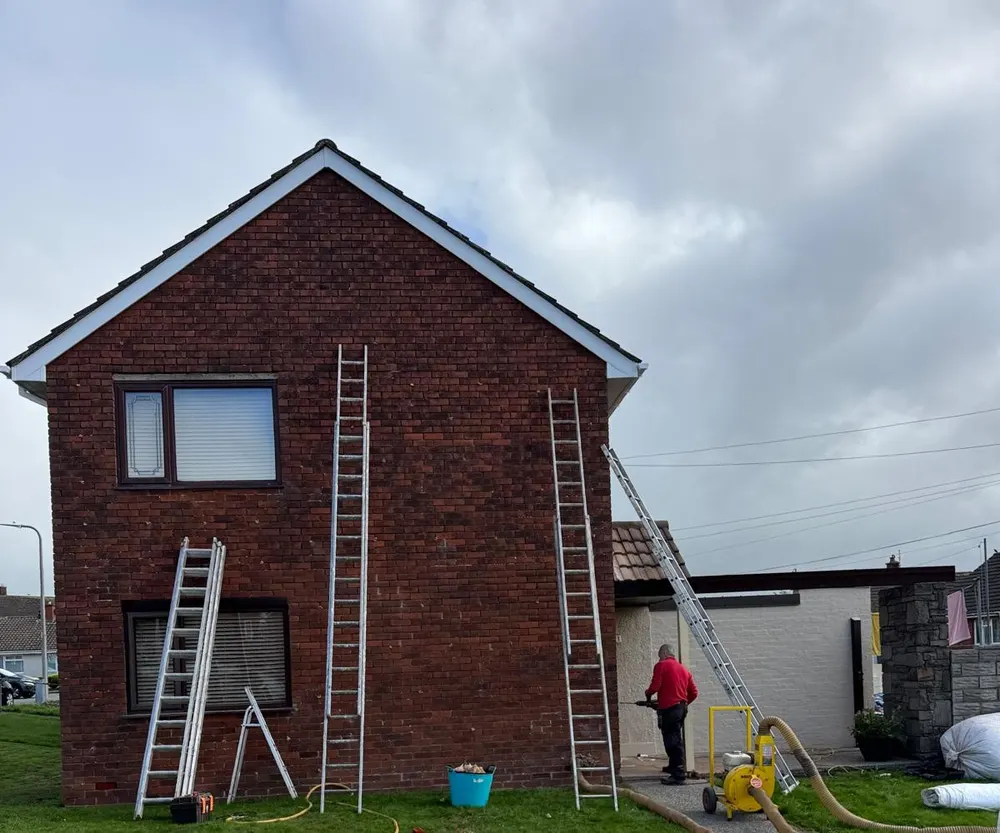
We drill the outer wall in a set pattern, then vacuum the beads out through the holes into sealed bags, working bonded beads loose first, until the cavity is clear down to the damp-proof course. Then we fill and make good every hole, fit air bricks and take the beads away for licensed disposal.
- Drilling. We drill the outer leaf in a set pattern across the whole wall, so every part of the cavity can be reached.
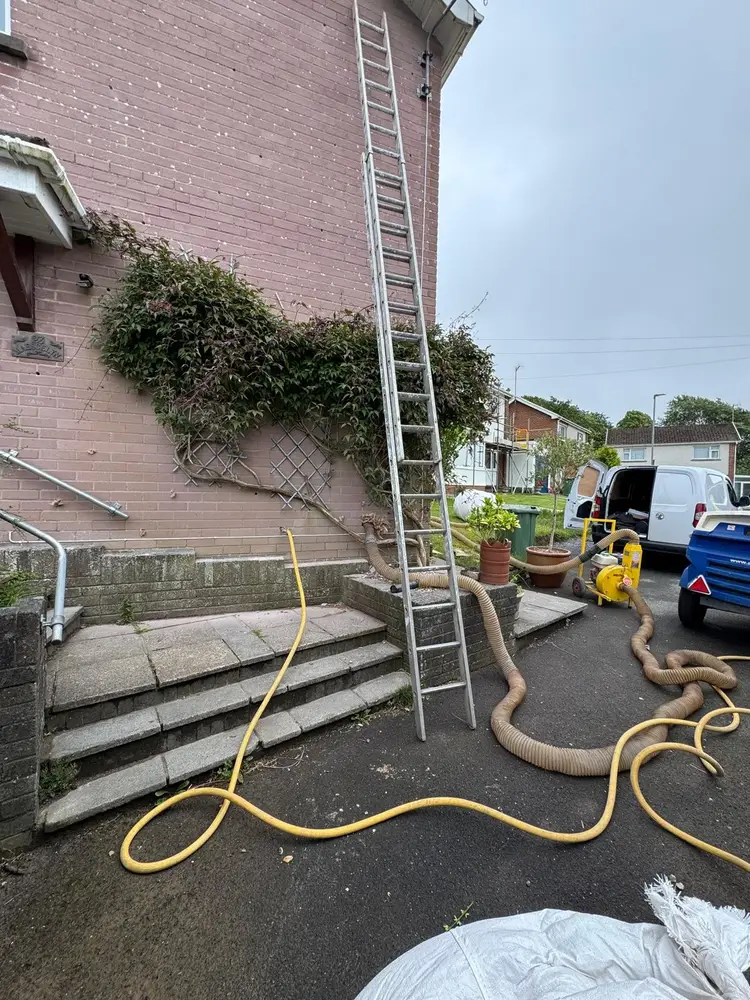
- Extraction. The extraction vacuum pulls the beads out through the holes and along the hoses into sealed bags. With bonded beads we work them loose first so they'll move. We keep going until the cavity is clear down to the damp-proof course.
- Keeping the beads under control. Polystyrene beads are light and get everywhere if they're given half a chance, so we keep them in the hoses and bags and clear up any strays as we go.
- Making good. Every hole we've drilled is filled and made good.
- Ventilation. We fit air bricks so air can move through the empty cavity.
- Disposal. The beads are taken away for licensed disposal.
Your photos and certificate.
Once the wall's clear, we take photos of the empty cavity and give them to you, along with a certificate of removal. They're your proof the beads are gone, and they're what a buyer's surveyor or a lender will usually ask for. We're fully insured as well.
Bead extraction prices.
In our estimator, bead extraction is priced at £21 per square metre of wall (as of November 2026), the same rate as mineral wool, with a minimum job of £1,250. The wall area is worked out from your house type, the number of storeys and how many walls you need doing. The cost guide explains how that's calculated.
For a guide price on your own home, use the estimator on our home page. Your fixed price follows the borescope survey.
Areas we cover.
We work from Llanelli, and most of our bead jobs are in South Wales, from Pembrokeshire and Carmarthenshire across to Cardiff and Newport. We also take enquiries from right across the UK. If you're in the north of England, your enquiry goes to our partner, CavExtract.
Common questions about bead removal.
Will beads pour out everywhere when you drill?
Loose beads will try to, which is why the extraction hose goes on as soon as a hole is made and we clear up as we go. Bonded beads stay put until they're loosened.
I've seen beads coming out of a vent. Does that mean they've all gone?
Not usually. Beads escaping from a vent or a gap tells you there's loose fill in there, but plenty can still be left in the wall. The borescope will show how much.
Does bonded bead cost more to remove?
Our estimator uses one rate for bead fill, £21 per square metre. Your fixed price is confirmed after we've seen the wall on the survey.
Can I get the beads out myself?
It's not something we'd suggest. Without extraction kit you'd struggle to reach the whole cavity, loose beads are hard to contain, and the waste has to go for licensed disposal. You'd also have no certificate to show anyone afterwards.
For an overview of the whole job, whatever's in your walls, see our cavity wall insulation removal page.
Get a guide price for your walls.
Our online estimator gives you a guide price in about a minute. Or ring us and we'll talk it through.
Get my free estimateCall 07728 291907