
Signs your cavity wall insulation has failed
Hardly anyone finds out their cavity wall insulation has failed by looking at it. You can't see it, because it's hidden between the two layers of your outside walls. What people notice is the house: a bedroom wall that always feels cold, a damp mark that's back a month after you painted over it, or a surveyor's report with a line about the cavity fill. This guide goes through the signs we hear about most, what tends to be behind each one, and how to find out for certain what's in your walls.
What failed insulation actually means.
Cavity wall insulation has failed when it no longer stays dry and evenly spread from the top of the wall to the bottom. It may have got wet and stayed wet, dropped to the bottom of the wall, settled and left empty gaps, or broken down with age.
In some houses the fill was never a good match for the walls to begin with. That's a different story, but you end up with the same signs and the same question about what to do next.
Signs you'll notice indoors.
The signs you'll notice indoors are a cold patch on an outside wall, damp marks or mould that keep coming back, a musty smell you can't get rid of, and heating bills that keep going up. None of them proves the insulation has failed on its own, but together they're worth checking.
A cold patch on an outside wall.
On a cold day, put your hand flat against an outside wall, then try a few other spots on the same wall. Some difference is normal near windows and corners. A patch that feels clearly colder than the wall around it, and stays that way, can mean the fill behind it is wet, or that there's very little fill there at all.
Damp marks or mould that keep coming back.
This is the one most people ring us about. A grey or brown stain on the inside of an outside wall, or mould in the corners, along the skirting or behind a wardrobe pushed up against an outside wall. You clean it, you paint it, and it comes back. When that happens on outside walls and not on the walls between rooms, the cavity is worth checking.
Be careful with this one, though. Damp can have more than one cause, a leaking gutter or a fault in the brickwork for example, and the cavity fill isn't always to blame. It's a reason to have a look, not proof on its own.
A musty smell you can't get rid of.
Some rooms just smell damp, even with the windows open and nothing obvious to see. If it's a room with one or more outside walls, it often goes along with the marks above, sometimes before they show.
Heating bills that keep going up.
Higher bills often turn up alongside the other signs here, but bills rise for plenty of other reasons, so on their own they tell you very little. If yours have crept up and you've also got a cold wall or damp patches on the same outside walls, mention it when you ring us.
Signs on the outside of the house.
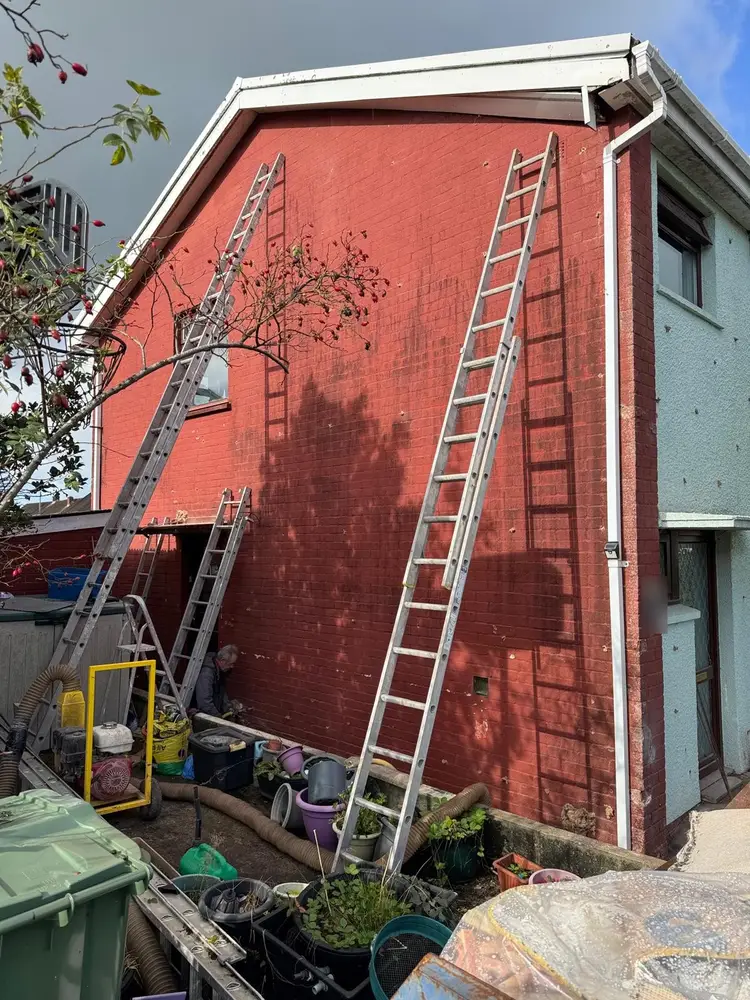
Here in South Wales, wind-driven rain hits some walls far harder than others (the Building Regulations' Approved Document C maps how exposed each part of the UK is to it). Gable ends and walls facing the sea or an open hillside usually show trouble first, so walk round and look at the walls that face the weather.
That's why so many of the jobs we see involve only one or two walls rather than the whole house.
A few other things are worth noting:
- Beads coming out of a vent or gap. If you've seen little white polystyrene balls trickling out of an air brick, a hole for a cable or a crack in the mortar, you've got loose bead fill. It doesn't mean the wall has emptied itself, and there's usually plenty still inside.
- Worn brickwork or pointing. Crumbling mortar joints and weathered bricks let water into the outer layer of the wall, and from there it can reach the fill.
- Gutters and downpipes. A gutter that overflows or a cracked downpipe can soak the same patch of wall every time it rains.
None of these prove the insulation has failed. They're the routes water takes to get into a wall, so if you've got one of them and damp marks on the same wall inside, the two are probably connected.
What failure looks like for each type of fill.
There are three common fills in British cavity walls, and each one goes wrong in its own way. Wet mineral wool gets heavy and sinks, polystyrene beads settle and leave gaps near the top of a wall, and some older foams turn brittle or shrink away from the brick.
Mineral wool is fibre that was blown into the wall. Once it's wet it gets heavy and can sink, so the top of the wall ends up with hardly anything in it while the bottom is packed tight and holding water. Our mineral wool extraction page explains how we get it out.
Polystyrene beads don't soak up water the same way, but they can settle over the years and leave gaps near the top of a wall, and loose beads will escape through any opening they find. See polystyrene bead extraction.
Foam was injected and set hard. Some older foams turn brittle or crumbly, and in some walls the foam has shrunk away from the brick in places. Taking it out is slower work, as our foam insulation extraction page explains.
When a surveyor raises it.
Sometimes the first sign is a survey rather than anything you've noticed. If you're buying or selling, the surveyor or the lender may ask about the cavity fill and what condition it's in. That doesn't mean it has failed, but you'll need an answer, and photos of the cavity with a certificate of removal give one.
We give you both at the end of every extraction.
How to find out for certain.
The only way to know for certain is to look inside the wall, and that's the first thing we do. We drill one small hole and put a borescope, a camera on a cable, into the cavity. It shows what the fill is and whether it's wet, slumped or full of gaps.
Then we tell you straight what we've seen. If taking the insulation out is the right thing for your walls, we'll give you a fixed price. If it isn't, or if your damp looks like it's coming from somewhere else, we'll say so. We won't tell you that removal will sort out every damp problem, because it won't always.
If it does need to come out.
We drill the outer wall in a set pattern, vacuum the fill out all the way down to the damp-proof course, fill and make good every hole and fit air bricks so the empty cavity is ventilated. What we take out goes for licensed disposal.
Our rates as of November 2026 are £21 per square metre for wool or beads and £31 for foam, with a minimum job of £1,250, and the cavity wall insulation removal cost guide shows what typical houses come to. For a figure for your own home, the estimator on our home page gives you a guide price in about a minute.
We're based in Llanelli and most of our work is across South Wales, but we take enquiries from across the UK. For the full picture of how we work, see our cavity wall insulation removal page.
Questions about failed insulation.
Can insulation fail on one wall and be fine on the others?
Yes, and it's common. The wall that takes the most rain, often a gable end, can be wet through while a sheltered wall on the same house is fine. We can clear just the walls that need it.
Does a cold wall always mean the insulation has failed?
No. Some difference around windows and corners is normal. A cold patch is worth checking when it's clearly colder than the rest of the wall, or when it comes with damp marks.
I've got mould. Is it definitely the cavity?
Not definitely. Damp and mould can have more than one cause. If it's only on outside walls and keeps coming back, the cavity is a likely suspect, and a borescope check will tell you more.
Do you charge to come and look?
Quotations are free. Ring us on 07728 291907 and tell us what you've noticed, and we'll talk you through what happens next.
Get a guide price for your walls.
Our online estimator gives you a guide price in about a minute. Or ring us and we'll talk it through.
Get my free estimateCall 07728 291907